Qualitative research methods: what you need to know

No amount of marketing wizardry or other business trickery can save a poorly designed website, app, or any kind of digital product. Your business can only reach its full potential when you invest sufficient time and resources to understand your customer.
A surefire way to go about it is to work with a UX researcher. User research methods, including qualitative and quantitative research, helps you have a solid insight into your target audience, which is essential for making informed product decisions.
In this article, we’ll focus specifically on how qualitative research helps you make sure that your product reflects actual user needs, not just the stakeholders and designer's biases, preferences, or assumptions.
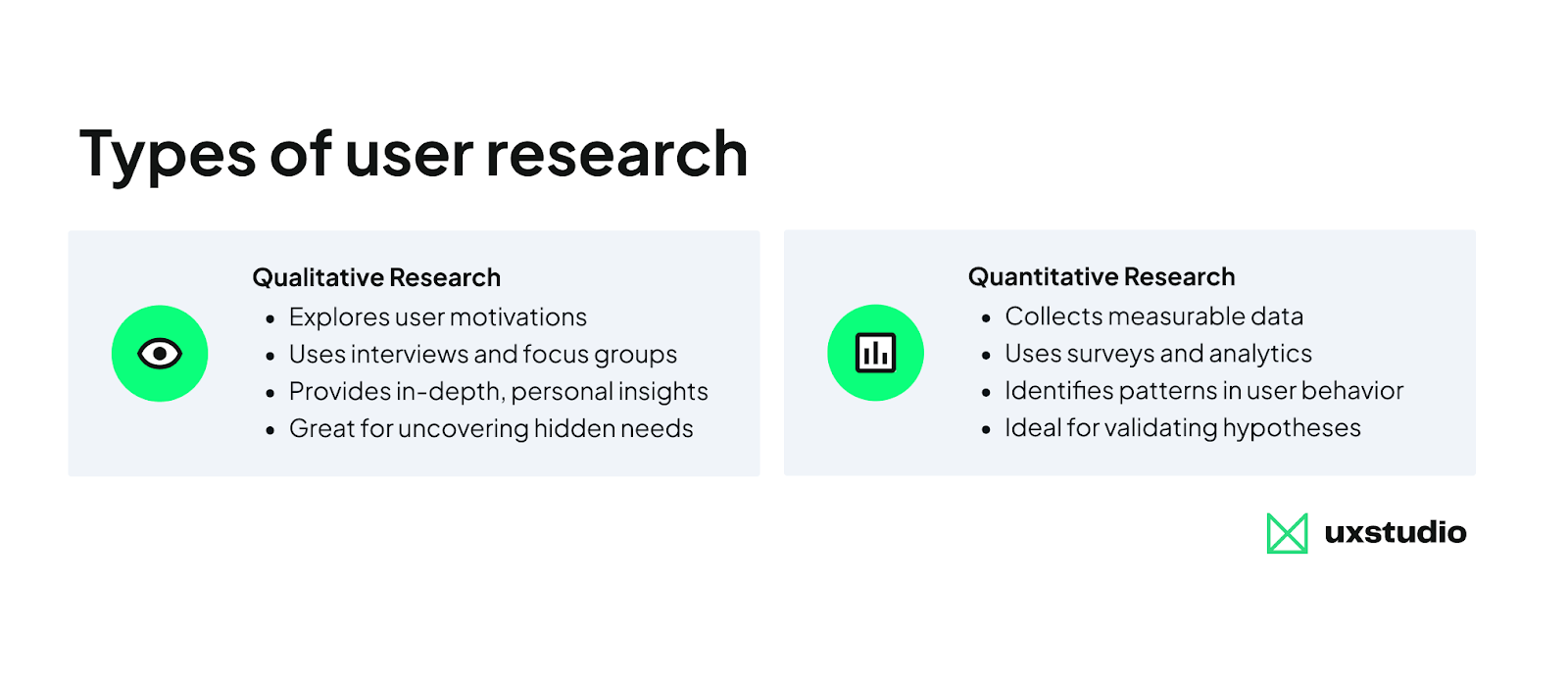
What’s the difference between qualitative and quantitative research?
The two methods aren’t mutually exclusive. You can combine the tools of both types to get a broad and detailed picture of the target audience. Still, understanding when to focus on which is essential.
Qualitative research records non-numerical data: typically observations and insights about user habits, problems, expectations, and behavior. This means that a smaller number of participants is sufficient. While we are doing qualitative research, we:
- Collect in-depth and comprehensive information
- Examine the why and how
- Produce insights and quotes
- Understand the context in which experiences occur
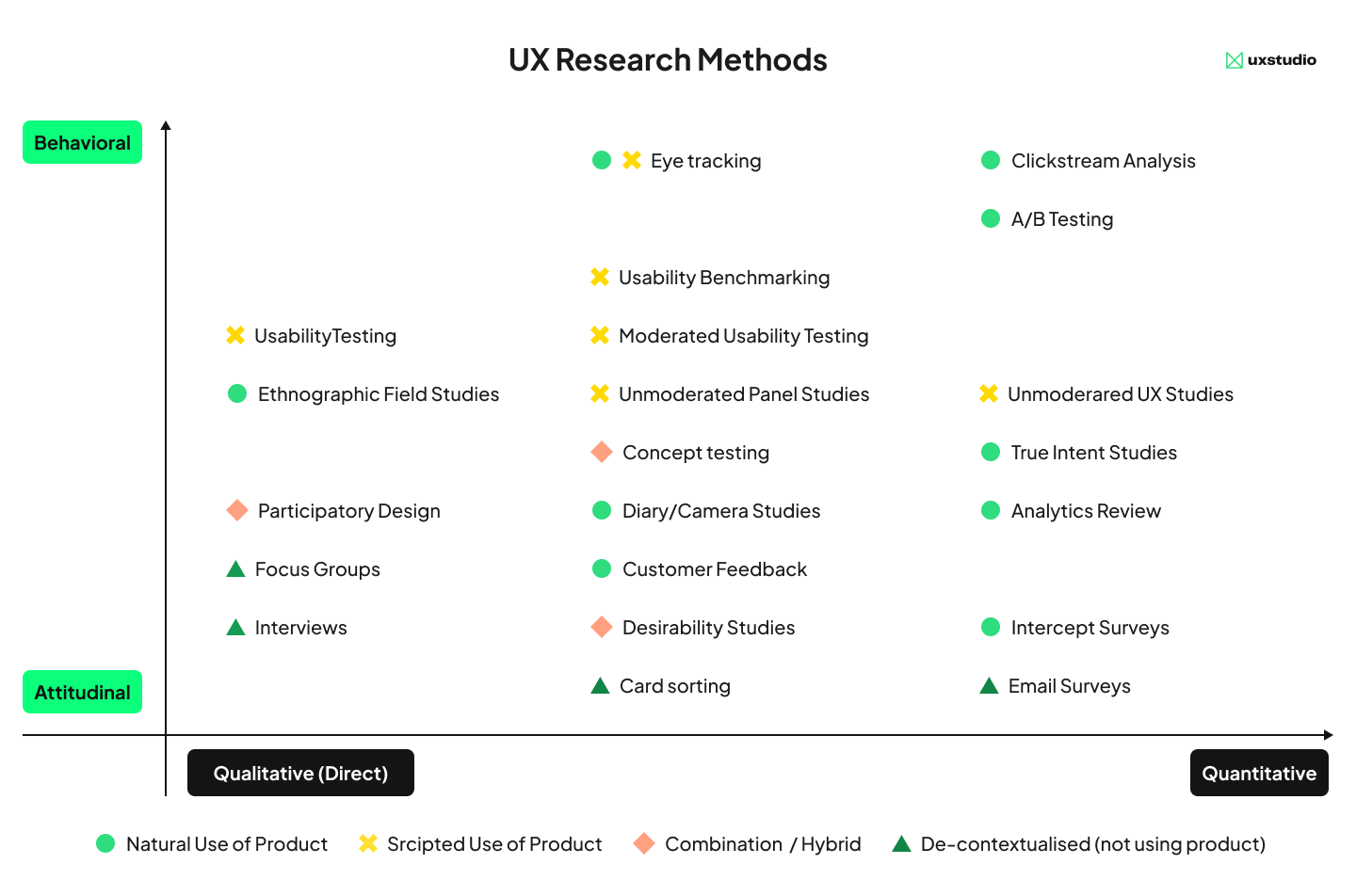
Examples: Usability testing, user interviews, card-sorting
In contrast, quantitative research measures data that can be quantified, which is why a large number of participants are required. The data collected can be, for example, the number of clicks on a website, or how many people opened an email. While we are doing quantitative research, we:
- Examine the what, when, where or who
- Do statistical or numerical analysis of data usage
- Produce numbers
Examples: A/B tests, surveys, web analytics
Common qualitative research methods in UX research
Qualitative research methods are best utilized when you aim to delve deep into understanding complex phenomena that cannot be quantified easily. These methods are particularly valuable when exploring your users’s:
- emotions,
- behaviors,
- motivations,
- and experiences.
These provide rich, nuanced insights that quantitative data alone cannot capture.

Let’s review the most commonly used qualitative research methods in UX.
1. Interviewing
User interviews are one of the most common methods of qualitative research. We conduct interviews for nearly all of our client projects, mostly during the discovery and validation phases.
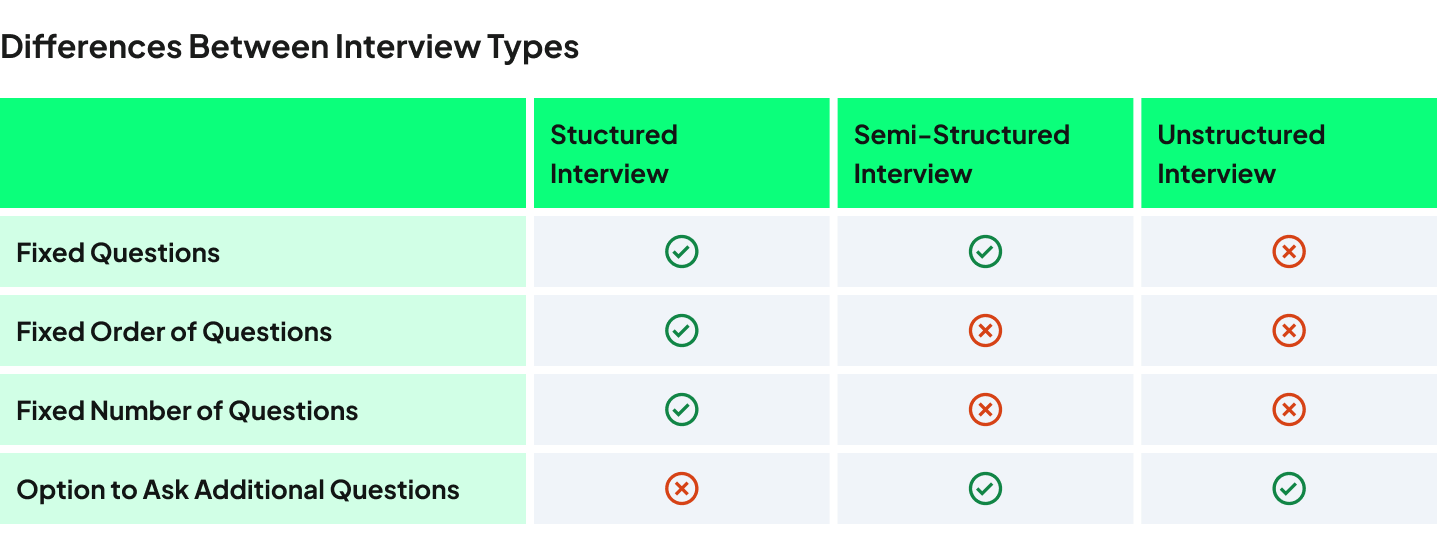
When interviewing users, researchers engage with participants in open-ended conversations to gather in-depth insights into their experiences, opinions, and perspectives. These interviews can be structured, semi-structured or unstructured, allowing for a flexible approach to data collection.
Interviews provide in-depth insights and generate useful direct quotes from participants on their experiences. They’re also wildly scalable and flexible, generating insights about practically any aspect of the user experience.
How to do it
Interviews can be conducted face-to-face or remotely. In a structured format the researcher follows a pre-written script (and asks the same questions from each participant), while in a semi-structured interview a loose format and script is followed but deviations are encouraged.
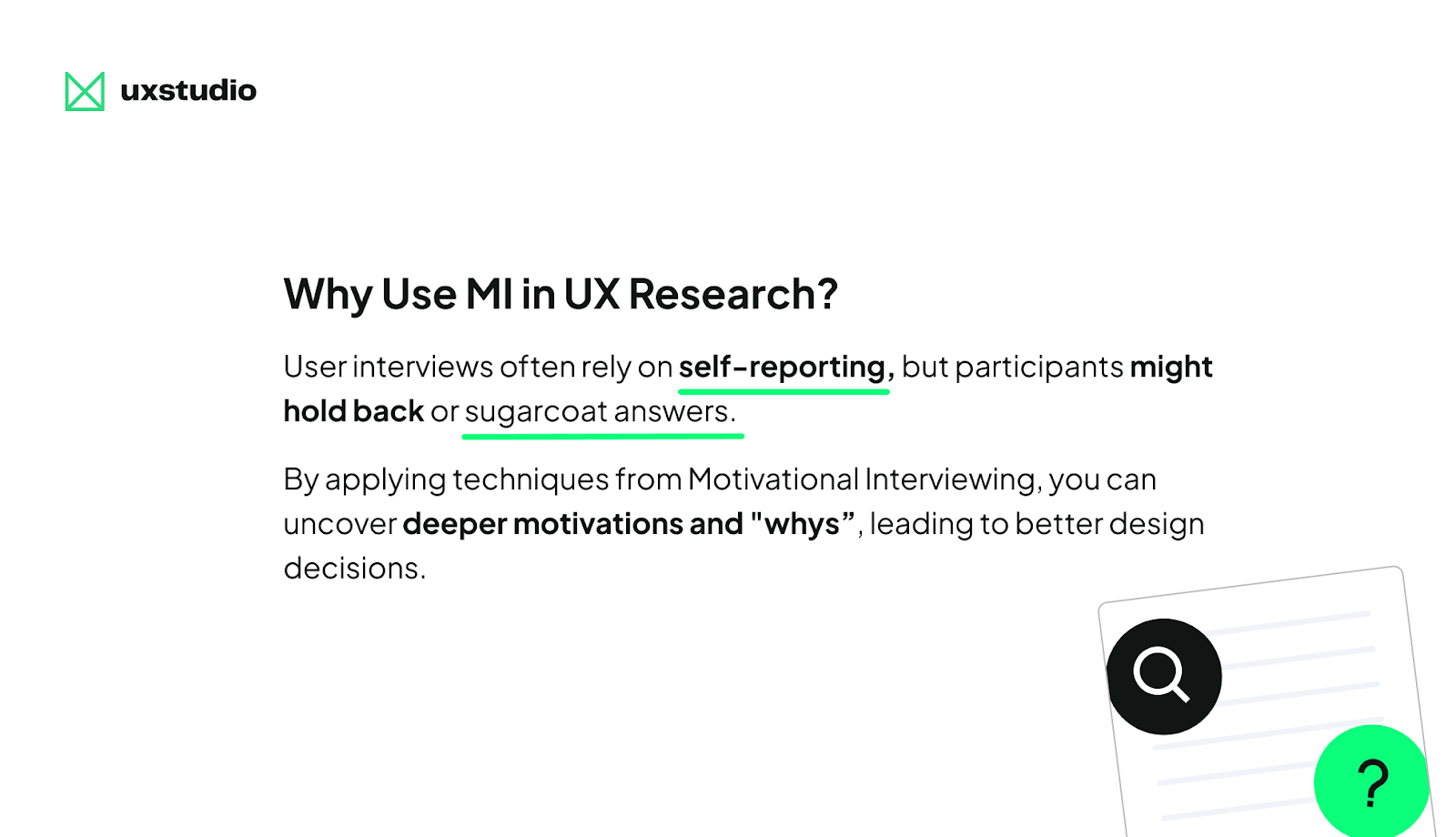
To run a good interview, researchers should talk about processes, feelings, and recent experiences. The interviewer’s attitude is also really important: the aim is to be open, curious, empathetic and objective. It’s helpful to reflect on the participant's thoughts by referring back to what they have shared, and asking them to go deeper. UX researchers will keep asking follow-up questions until they get to the root cause of user issues.
To go even deeper, we recommend using one of our favorite (and often overlooked) qualitative research methods, motivational interviewing.
The output
Five or six interviews will provide enough pain points to indicate a focus for the product. The frequency of the same results can help prioritize these problems.
Example
If a product manager wanted to uncover specific reasons for user churn, they could talk to users who have recently canceled their subscription to uncover added nuance beyond what raw data analysis might provide.
They could then use these insights to address pain points and hopefully retain future customers.
2. Usability testing
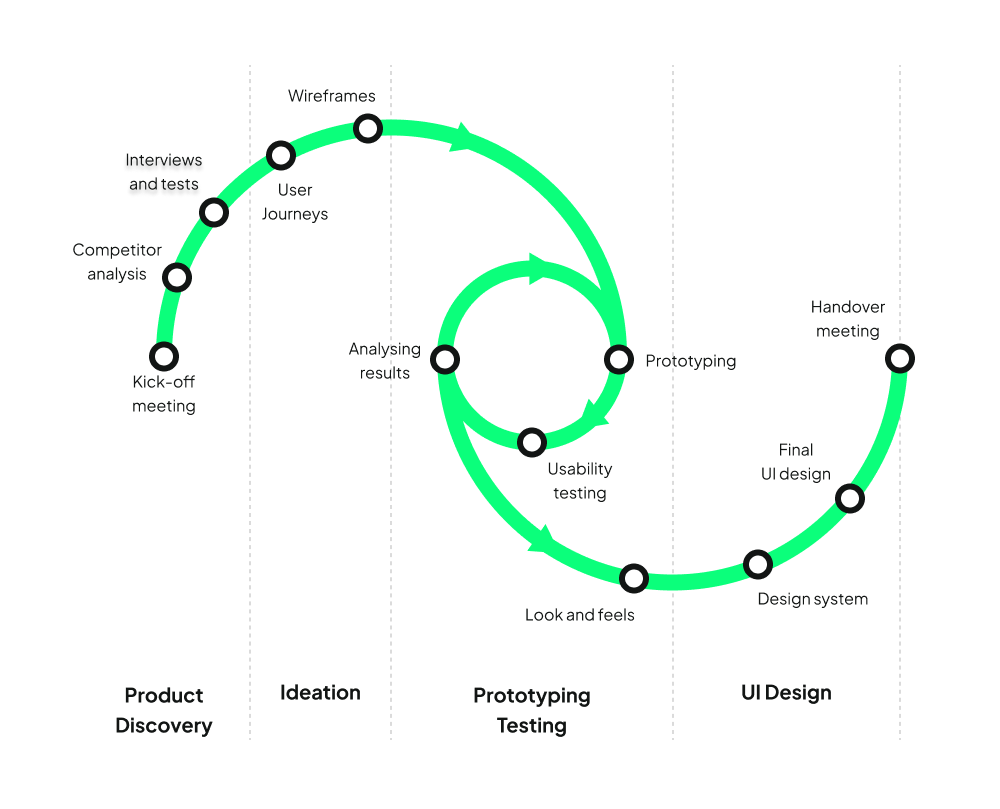
We can do usability testing very early in the design process to get initial feedback. Once you have a working prototype or even just a wireframe, you can start testing ideas. On more mature live products, usability testing is used to inform redesign.
Usability tests will uncover usability issues:
- Can your target audience understand the product easily?
- Where do they get stuck?
- What confuses or surprises them?
During a usability test, researchers give certain tasks to test participants, which they try to accomplish using the product. Researchers observe how they perform, noting the tiniest details.
At UX studio, we always test the prototype with members of your actual target audience to validate your
- concept,
- layout,
- features,
- copy
Based on our research findings, design iterations can effectively address the underlying usability issues.

How to do it
Tasks the participants will be asked to perform are planned beforehand.
Researchers then recruit test participants from your target group.
During the test, researchers pay attention and note whether there were instances of users:
- Hesitating
- Asking questions
- Revoking actions
- Encountering friction
- Not have clear understanding of something
The output
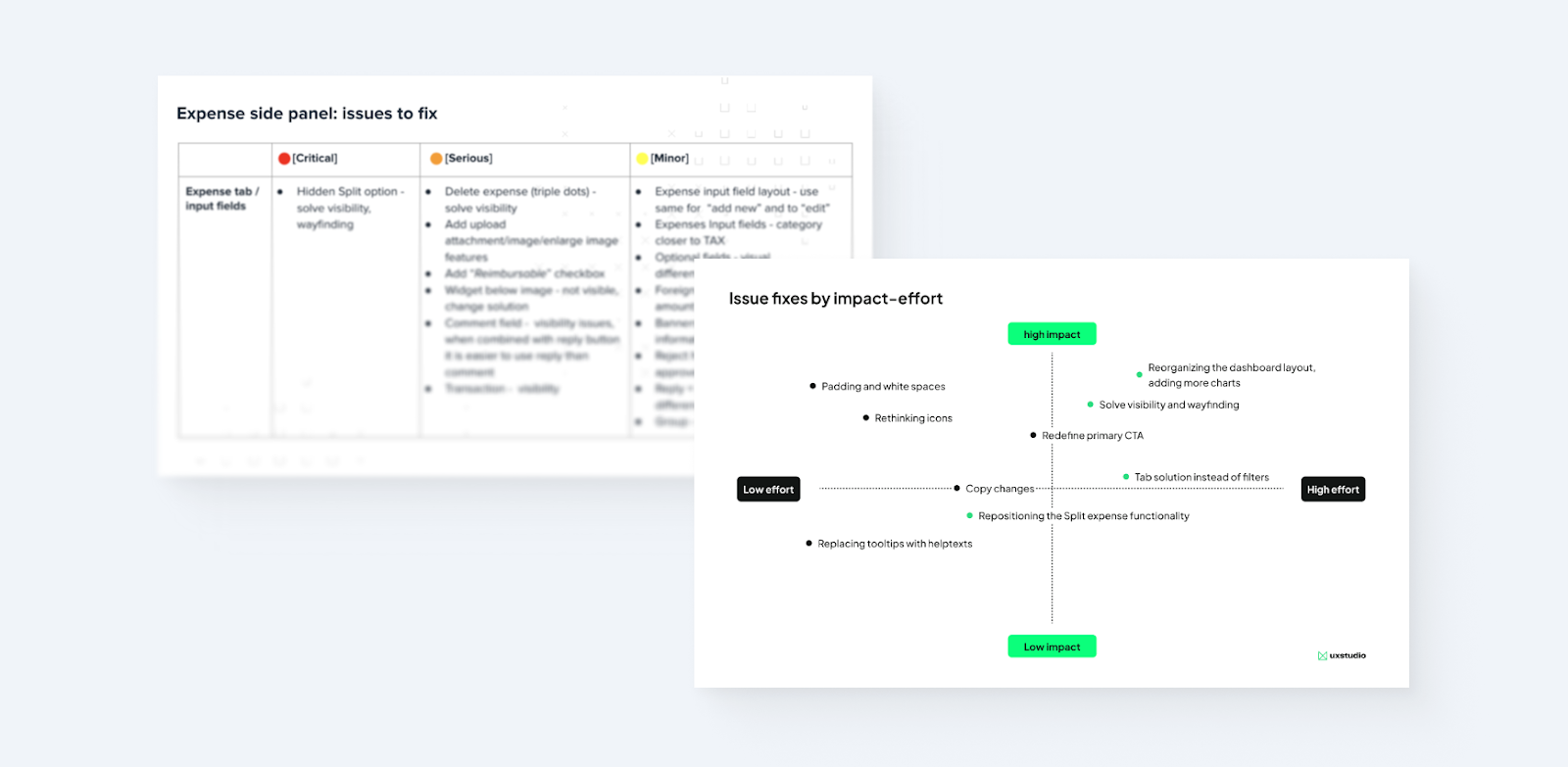
Individual tasks, as well as complete processes can be tested. This UX research method's output usually results in a qualitative report detailing all usability issues identified, as well as design recommendations.

Example
A new tool is being developed to track sales/compliance/HR processes, but usability testing reveals that while there are no classic usability issues, first time users find the tool complex and overwhelming.
This means that an extensive onboarding process and several tooltips will be needed to guide users and avoid adoption issues.
3. Card sorting
Card sorting helps create navigational structures and information architecture. This qualitative UX research method is especially useful for websites with heavy menu structures and submenus. This method can also help you find themes, categories and labels.
How to do it
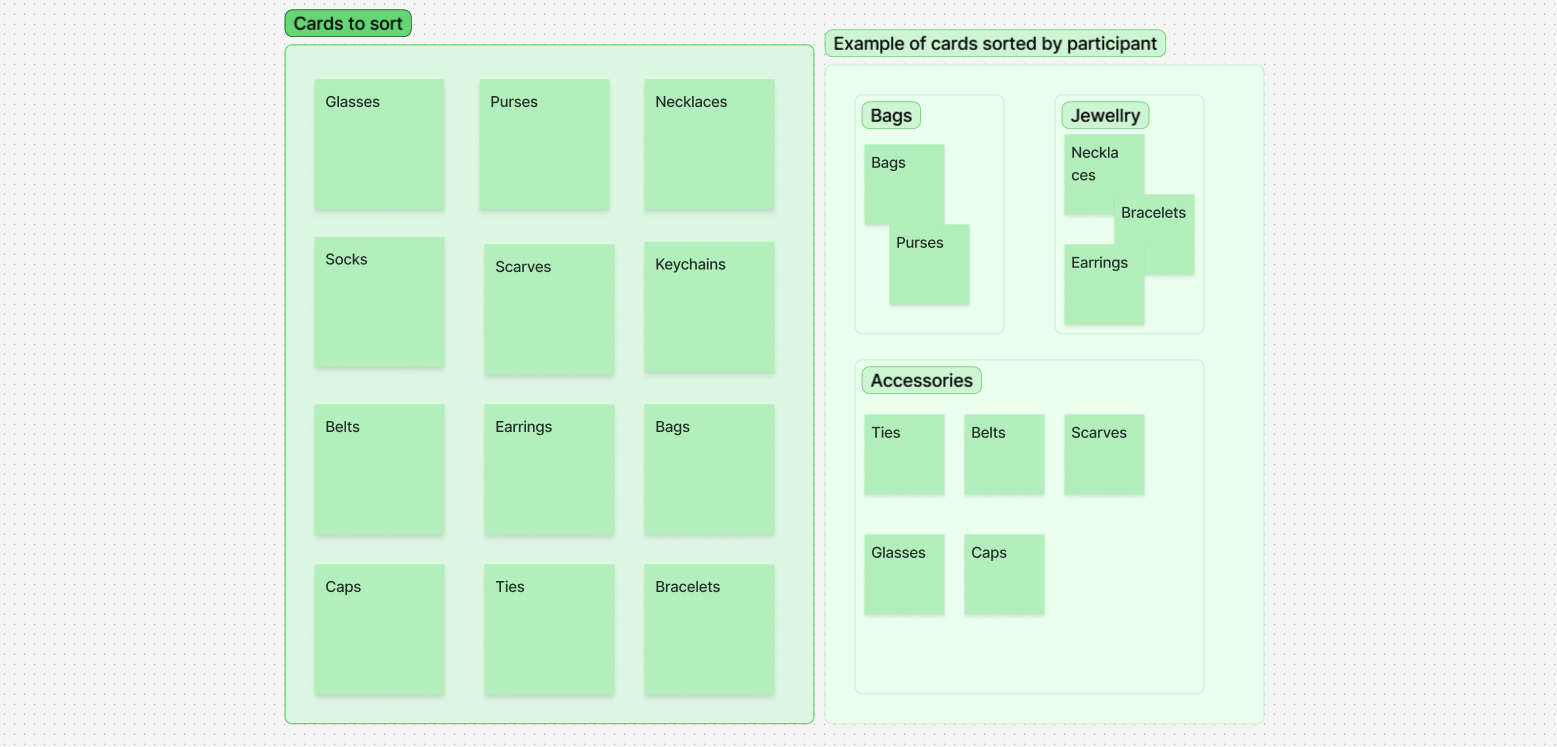
Using tools such as Optimal or Lyssna, researchers write product functions or content sections on movable cards. Then they ask the participants to organize them into groups. They can go about it two ways:
- Open: The test participants determine individually how many groups to create and what to name them.
The aim is to understand people’s mental models and figure out their structure. The phrases participants use to name their groups will provide a lot of qualitative information.
- Reversed (also called closed or tree-test): Here the elements need packing into existing categories or a tree-structure. Reverse card sorting aims to validate the structure defined after an open card sort.
The output
The UX researcher asks follow-up questions, analyzes the results, and proposes a research-based solution for page structure and hierarchy, so you can create an information architecture that matches your target group’s mental models.
When researchers run quantitative card sorting tests, they focus on statistical averages rather than the reasoning behind individual choices.
Example
An ecommerce website wishes to redesign their webshop to align with their new branding guidelines and expanding product portfolio. Card sorting can help create product categories and subcategories in the menu to make sure that customers are going to find the product that they are looking for with ease.
4. Other methods
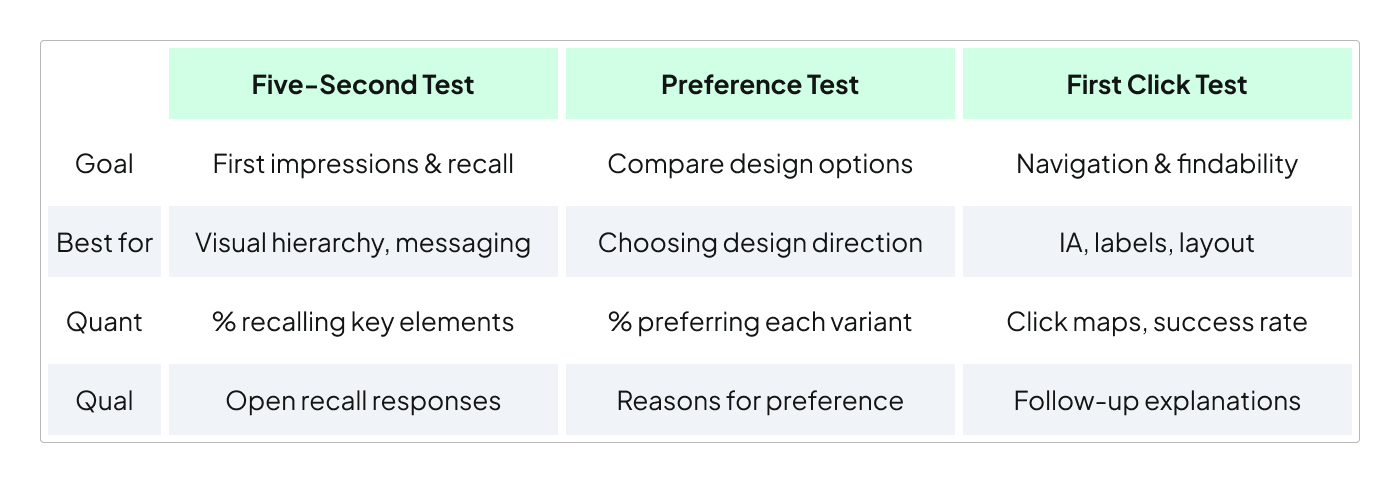
Methods such as five-second tests, preference testing and first click tests are mixed qualitative and quantitative methods, because they can be used to gather numerical data as well as qualitative insights, such as a participants’ reasoning, thoughts and expectations.
These methods can provide rapid feedback for iterative design. The downside is that they require more participants than interviews and usability testing, around 15-30 users.
- Five-second tests measure clarity, message recognition and first impressions.
- Preference testing is a quick way to compare design options and understand which version users prefer and why
- First click tests measure whether a user knows where to click to complete a task. It generates insights about information architecture and navigation clarity.
How to do these
For all of these tests, a simple screenshot of an application, website or tool is enough.
Five-second test
Participants view a design (webpage, screen, ad) for exactly five seconds, then answer questions about what they remember or understood.
Researchers use it to evaluate first impressions, assess whether key messages land immediately, and test visual hierarchy. It answers questions like "Does users notice the most important element?" or "Is the value proposition clear at a glance?"
Preference testing
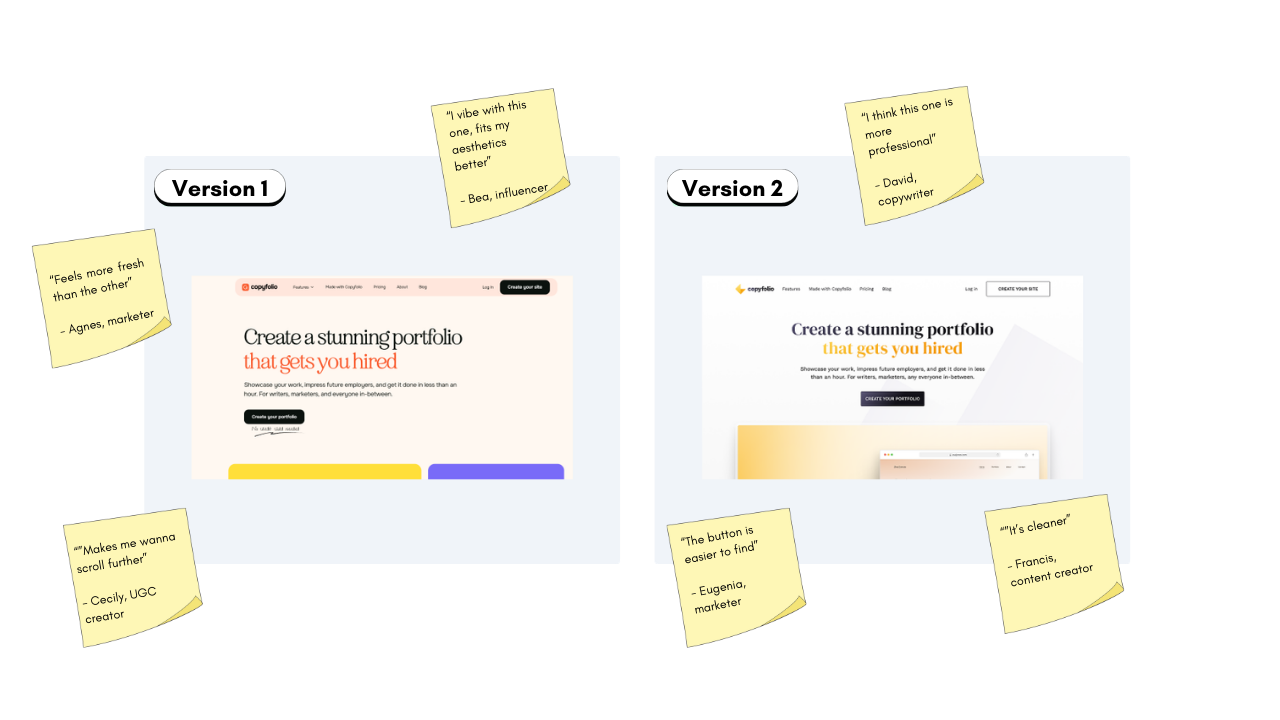
Participants are shown two or more design variations and asked which they prefer, often with a brief explanation of why.
Researchers use it to choose between design directions, validate aesthetic or layout decisions, and gather both a measurable preference split (quantitative) and the reasoning behind it (qualitative).
This method is commonly used in early-stage design, when multiple concepts are competing.
First click test
Participants are given a task and asked to click where they would first go to complete it on a design or prototype. Researchers capture where people click (quantitative — click maps, success rates) and sometimes why (qualitative — follow-up questions).
It's used to evaluate navigation design, label clarity, and information architecture, since research suggests that a correct first click strongly predicts task completion success.
The outputs
All three methods are considered mixed because they produce measurable data (success rates, preference splits, click coordinates) alongside open-ended insights into why users behave as they do, making them efficient for both validating hypotheses and surfacing unexpected patterns.
Conclusion
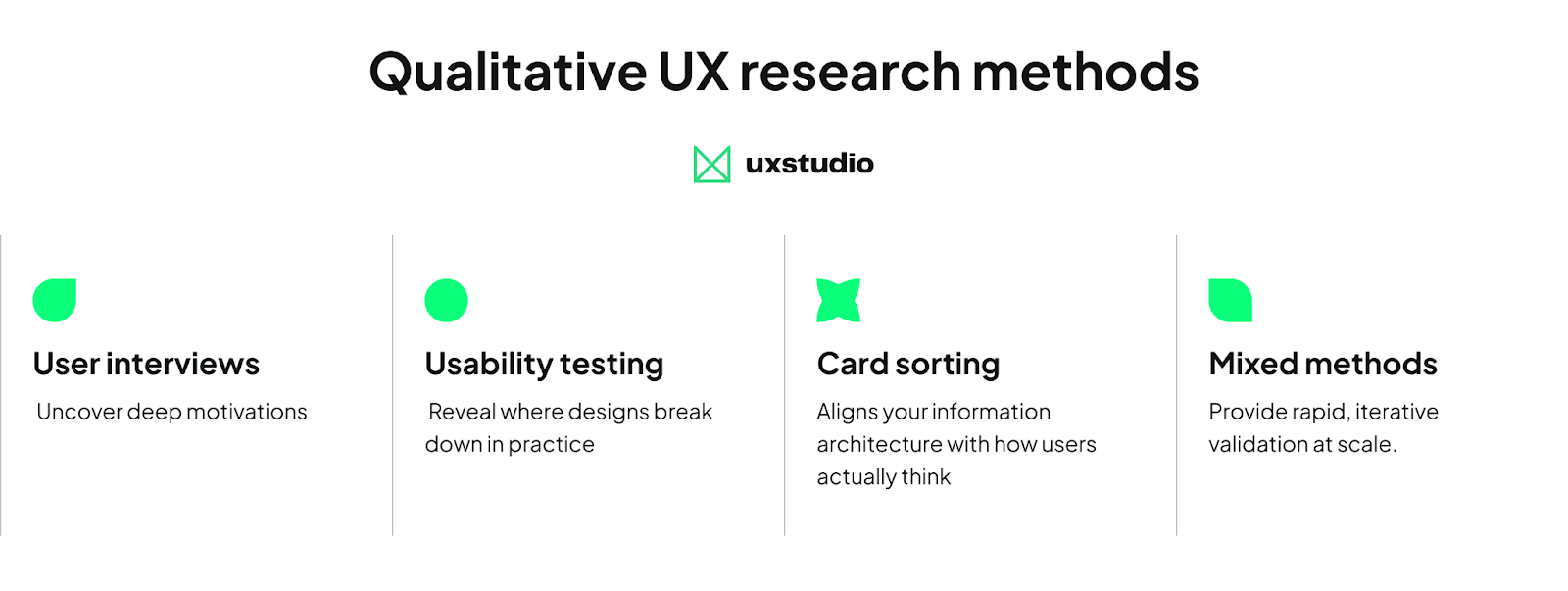
Qualitative research methods (whether interviews, usability testing, card sorting, or mixed methods) share a common purpose: replacing assumptions with evidence.
Each method offers a different lens on user behavior, and their real power emerges when used in combination.
When should you invest in qualitative research?
The short answer is: earlier and more often than most teams think. Many organizations treat research as a final validation step, something done to confirm that a nearly finished design is good enough. In practice, that approach limits how much research can actually improve a product, since major structural or conceptual changes are rarely feasible at that stage.
Qualitative research delivers the most value at key inflection points throughout the product lifecycle:
- Before design begins to understand real user needs and avoid building the wrong thing.
- During prototyping to catch usability issues before they become expensive to fix.
- After launch to understand why certain features aren't being adopted, or why users churn.
Even a handful of interviews or usability sessions at the right moment can prevent months of misguided development.
Why B2B companies choose to outsource UX research
For B2B companies, the stakes of poor UX are particularly high. Complex tools, long sales cycles, and demanding professional users mean that usability issues translate directly into lost contracts, failed onboarding, and low adoption, all of which affect revenue.
Yet research is frequently the first thing cut when internal teams are under pressure. Outsourcing UX research to a specialist agency solves this without the overhead of building an in-house team. Here's what that gets you:
- Objectivity. An external team has no stake in confirming existing assumptions, which means findings are more reliable and harder to dismiss internally.
- Speed. Agencies bring established processes, recruitment networks, and analysis frameworks that compress timelines significantly.
- Expertise across methods. Knowing which method to use, and when, is a skill in itself. An experienced UX agency will select the right combination of methods for your specific research questions and budget.
- Stakeholder buy-in. Research delivered by an external expert often carries more weight in internal decision-making, helping product and design teams advocate for user-centered changes.
Remember that the value of research is only realized when findings actually change what gets built. A good UX agency doesn't just deliver a report, but works with your product and design teams to translate findings into prioritized, actionable recommendations that fit your roadmap and development constraints. Reach out to us to work with academically trained, proactive researchers.
Credits
This blog post was written by: Fruzsina Fejes, UX researcher
Edited by: Dr. Johanna Székelyhidi, marketing manager